The Hidden Cost of “Free” Antivirus on Your Business Machines
You’ll find free antivirus software everywhere. It installs in minutes, doesn’t ask for anything upfront, and makes it easy to check the “we have security software” box. It feels like a reasonable call for a business owner managing tight budgets.
In reality, it rarely is a reasonable call. The real cost does not appear on an invoice; it shows up in a ransomware recovery bill, a breach notification that you have to send to your clients, a compliance violation, or a reputation hit that takes you years to recover from. By the time the damage is visible, the decision to go for a free antivirus is long forgotten.
This is a growing problem globally, particularly in Pakistan, where the threat landscape has escalated sharply, and businesses of all sizes are being targeted.
Pakistani Businesses Are Already in the Crosshairs
According to Kaspersky, Pakistan recorded more than 5.3 million on-device cyberattacks in just the first three quarters of 2025. This is not a global statistic; this includes businesses in Karachi, Lahore, Islamabad, and every other major commercial hub across the country.
24% of Pakistani corporate entities encountered malware infections during that period, delivered through infected USB drives, phishing links, and hidden software installers. Ransomware, spyware, trojans, and password stealers were all present in the mix. The banking sector, separately, saw a 114% rise in cyberattacks in 2024, with phishing and ransomware leading the charge.
In August 2025, Pakistan Petroleum Limited was hit by the Blue Locker ransomware group. Kaspersky had reported earlier that nearly 8,500 SMB users in Pakistan had been targeted by malware disguised as legitimate productivity tools that included fake versions of Zoom, Microsoft Office, and similar software that employees installed without suspecting anything was amiss.
When employees install software from unofficial sources because the official version costs money, they are not just bypassing a license fee, but opening a direct path for malware onto business machines. And if the antivirus protecting those machines is also a free product with no zero-day capability, no behavioural detection, and no central monitoring, then there is nothing standing between that download and a serious incident.
What “Free” Actually Means
A rule of thumb is that nothing in technology is truly free. The free security software has to be funded somehow, and in several well-documented cases, that funding came from users’ own data.
In 2024, Avast was fined $16.5 million by the FTC after finding that the company had spent years collecting detailed browsing data from its free antivirus users and selling it to advertisers, data brokers, and investment firms. The data consisted of search queries, health concerns, website visits, and financial information. All of it was harvested by software that people installed specifically to protect their privacy. Jumpshot, Avast’s analytics subsidiary, passed this information to more than 100 third parties.
When a business deploys free antivirus across its machines, every device becomes part of the arrangement. That includes devices handling sensitive communications, client files, and financial records.
Beyond the privacy risk, free tools consistently lack what businesses actually need:
- No zero-day protection: Free antivirus software works from a signature database, a catalogue of threats that have already been identified. Anything new, anything custom-built, anything that has not been seen before gets straight through. That is precisely the kind of threat attackers are deploying most aggressively right now.
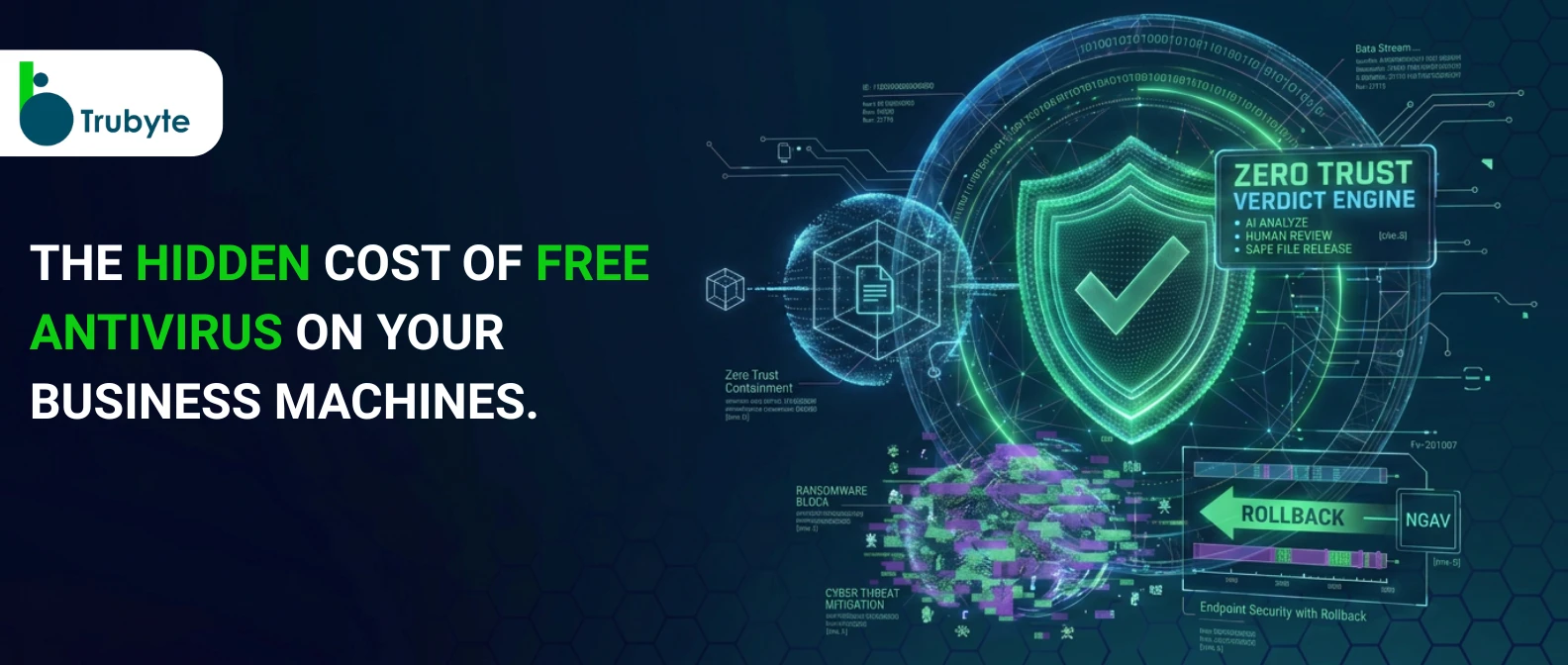
- No ransomware rollback: If ransomware starts encrypting your files before the antivirus triggers a detection, a free tool cannot undo that damage. The files stay encrypted. Proper endpoint security platforms include rollback capabilities that can reverse the damage before it becomes permanent.
- No centralised management: A free antivirus installation protects one machine. It has no visibility into any other device in your organisation. There is no central console, no way to push policy updates, and no way to confirm whether any endpoint is current or has already been compromised. For a business managing ten, twenty, or fifty devices, that is ten, twenty, or fifty separate blind spots.
- No compliance documentation: Cyber insurance providers and regulatory frameworks increasingly require evidence that security controls are in place and enforced. Free antivirus produces no audit logs, no policy records, and no documentation of any kind. If you ever need to demonstrate your security posture, a free tool gives you nothing to show
What Happens When It Fails:
In 2025, ransomware was involved in 44% of all data breaches. The recovery costs for SMBs averaged $1.53 million, excluding any ransom that was paid. The average downtime after an attack is 24 days, which is three and a half weeks of lost operations at an estimated $53,000 per hour.
In Pakistan, for a business running on thin margins, 24 days of downtime is not a setback; it is a potential closure. Ransomware groups are well aware of this, and they target smaller businesses specifically because the pressure to pay is higher than the recovery capability. A ransom demand of $50,000 would barely register to a large enterprise, but it represents a month’s revenue for a business with 30 employees.
A Mastercard survey of over 5,000 SMB owners globally revealed that nearly one in five who experienced a cyberattack went bankrupt or closed entirely.
A business might save $1,500 to $2,500 per year on security software by running free antivirus software across 20 machines, but a single ransomware attack can wipe out more than a decade of that saving, before factoring in client notification costs, legal exposure, or reputational damage.
The cost of proper endpoint protection is not a line item to cut. It is a business continuity decision.
Why Xcitium Is the Right Answer:
Xcitium assumes any unknown file could be a threat and contains it before any damage can be done. It does not try to detect threats and respond to them.
This is called Zero Trust containment, built around Xcitium’s patented ZeroDwell technology. When any unknown executable attempts to run on a protected device. Whether it arrived via a phishing email, a USB drive, or a software installer that turned out to be something else, it is automatically placed inside a virtualised container at the kernel level. The file runs normally inside the container, so the user notices nothing. But it cannot access real system data, files, or processes.
Xcitium’s verdict engine then analyses the file using AI and human researchers. Safe files are released. Malicious files stay contained and are blocked globally across all Xcitium deployments.
This is what stops ransomware before encryption begins. The payload executes. Inside a sandbox where it cannot touch anything real. The business keeps running.
This capability is especially relevant in the Pakistani business environment, where malware frequently arrives via USB devices and disguised software installers. These are exactly the vectors that signature-based free antivirus is worst at catching. An unknown executable delivered by USB is not in any signature database yet. Under Xcitium, it does not matter. It gets contained the moment it tries to run.
Xcitium also addresses the centralised management gap that free antivirus leaves open. Every endpoint is visible and managed from a single cloud console. Policies are enforced across all devices simultaneously. If something happens on any machine in the organisation, there is immediate visibility. Not a discovery made days later when the damage is already done.
It includes next-generation antivirus (NGAV) as standard, making it a complete replacement for free or legacy tools, not an additional layer.
The One Question to Ask
Before putting free antivirus on business machines, ask: if this fails and we face a breach, what does recovery actually cost?Factor in 24 days of downtime. Factor in lost revenue, emergency IT costs, client notification, and the long process of rebuilding trust. Then compare that against the cost of Xcitium.Businesses running free antivirus software are not saving money. They are deferring a cost that compounds with every day the exposure persists. They end up paying for it out of a crisis budget when it finally arrives.
Work with Trubyte
At Trubyte, we help businesses replace free and legacy antivirus with properly managed endpoint protection that fits their actual risk profile. We assess your current exposure, deploy Xcitium where it fits, and manage it as part of a broader security strategy. If your business is running free antivirus, and you want to understand what that exposure looks like, reach out. We are glad to have that conversation.